
Every winter, the same thing happens across the United States.
Millions of people wake up to no hot water, frozen pipes, or broken heaters.
And the first thing they do is not call a technician.
They search on Google.
Right now, searches for “hot water”, “no hot water”, and “water heater not working” are surging in the US.
That surge is not random. It is a real-time signal of buying intent.
If you own an HVAC business and you are not showing up when this happens, you are invisible exactly when customers are ready to pay.
This is where Google Trends becomes one of the most powerful SEO tools you can use.
Why “hot water” is a money keyword?
When someone searches:
- “no hot water”
- “water heater not working”
- “boiler not heating water”
They are not researching.
They are in pain.
These searches trigger:
- Emergency calls
- Same-day service requests
- High conversion phone leads
- High Google Ads CPC
In other words, these are some of the highest value searches in HVAC.
But most HVAC websites are not built to capture them.
How Google Trends reveals HVAC emergencies?
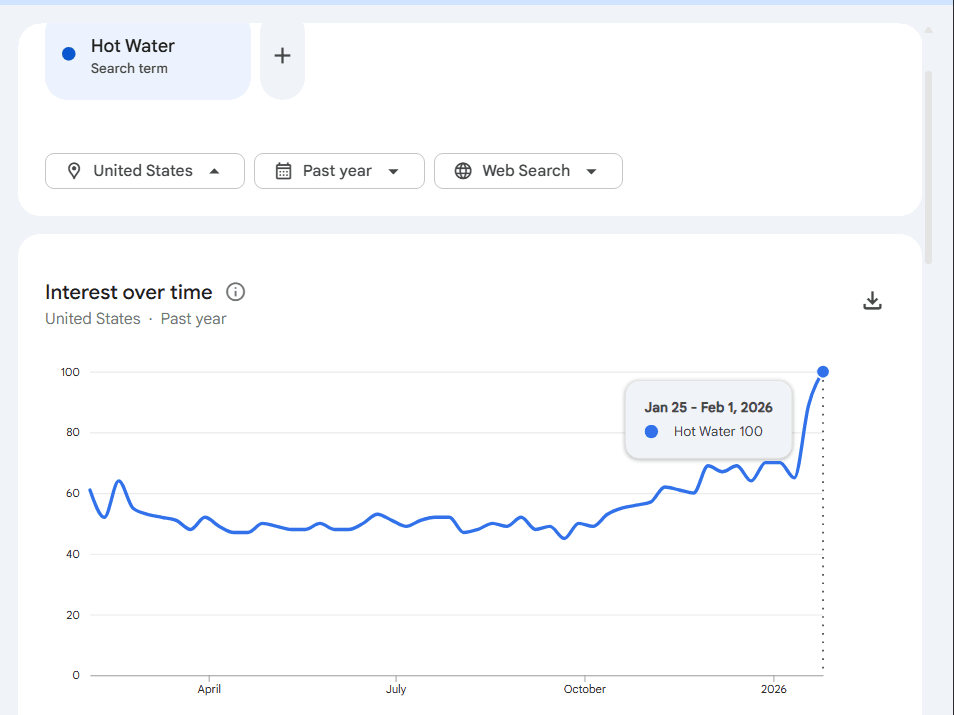
Google Trends shows you when people start searching for problems. This lets you predict demand before your competitors react.
When “hot water” spikes in a state or city, it usually means:
- Cold weather just hit
- Water heaters are failing
- Boilers are under stress
- Pipes are freezing
This creates a short window where thousands of customers are actively searching for help.
SEO lets you capture this traffic without paying for every click.
The keyword goldmine most HVAC sites ignore
Here is where most HVAC businesses go wrong.
They optimize for:
- “HVAC company near me”
- “heating and cooling services”
- “air conditioning repair”
Those are competitive and generic.
But emergency searches are different.
People search problems, not brands:
- “no hot water near me”
- “water heater leaking”
- “boiler stopped working”
- “shower water cold”
These keywords have:
- Lower competition
- Higher urgency
- Higher conversion rates
Google Trends helps you find when these problems explode in search volume.
How to turn trends into SEO traffic
Here is the exact strategy.
Step 1: Track problem-based keywords
Do not track “water heater”.
Track problems:
- no hot water
- water heater not working
- boiler not heating
- cold shower
When these spike in Google Trends, that is your signal.
Step 2: Create dedicated emergency pages
Most HVAC websites try to cover everything on one service page.
That is why they lose.
You need pages like:
- “No Hot Water Repair in [City]”
- “Emergency Water Heater Repair in [City]”
- “Boiler Not Heating Water in [City]”
These pages should be:
- Problem focused
- Location focused
- Phone call focused
They should not be generic blog posts with just FLUFF content.
Step 3: Match search intent
Someone searching “no hot water” does not want to read 1,500 words.
They want:
- Is this dangerous?
- How fast can someone come?
- How much will it cost?
Your SEO pages must answer those questions immediately.
This is where most HVAC SEO fails.
Step 4: Win the local map pack
When these searches spike, Google shows:
- Local map results
- Google Business Profiles
- Call buttons
If your profile is not optimized for water heater and boiler emergencies, you will not show up.
You do not just need SEO.
You need emergency-focused local SEO.
Why this strategy beats Google Ads?
When hot water searches spike, Google Ads becomes expensive.
HVAC companies start bidding aggressively.
SEO lets you:
- Appear without ads
- Capture free clicks
- Get phone calls without paying per lead
Once your pages are ranking, every cold wave becomes a lead generator.
What this means for HVAC business owners
Google Trends is not a curiosity tool.
It is a demand radar.
When you connect it with:
- Emergency service pages
- Local SEO
- Problem-based keywords
You build a website that makes money when customers are desperate.
That is where the real revenue is in HVAC.
Want this built for your business?
Most HVAC websites are not structured to capture emergency demand.
They miss thousands of dollars every winter.
If you want to:
- Rank for “no hot water” searches
- Show up when Trends spike
- Turn cold weather into booked jobs
Book a call with me.
I will show you exactly how your HVAC site should be structured to dominate these searches.
👉 Book your HVAC SEO strategy call or just email at seobulletinofficial@gmail.com for a 15 min short call.

This is Muhammad Asad. I like to play table tennis and love Digital Marketing and SEO. I have 7+ years of SEO experience. I would love to chat, discuss or break down any SEO or website problem.