
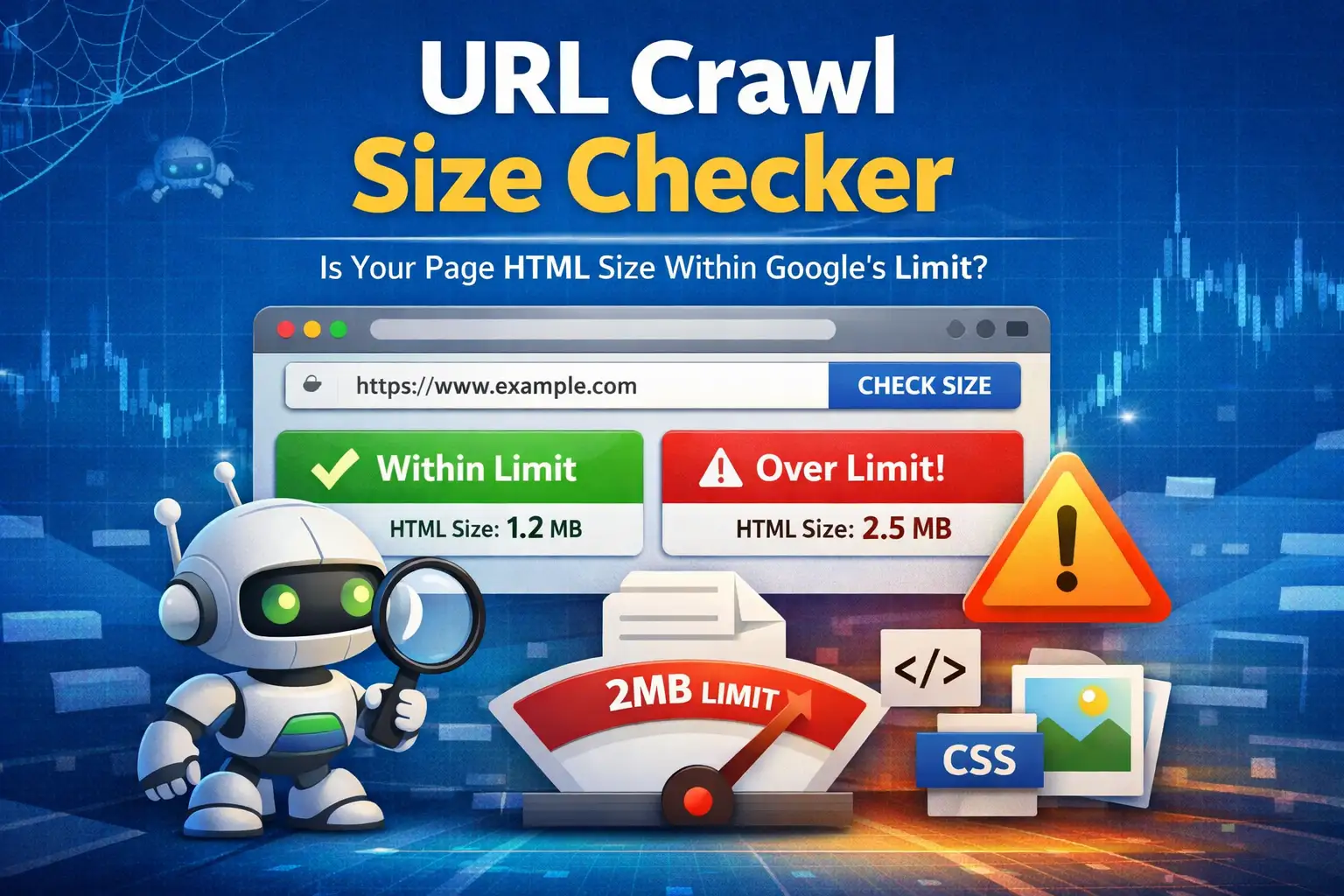
Enter your URL below and see if it is right what Google can crawl or not since the new 2MB crawl size announced by Google on Search Central blog.
Related:
URL Length Checker Free SEO Tool
Table of Contents
What is a URL Crawl Size Checker?
A URL Crawl Size Checker is an online SEO tool that measures the HTML size of a web page and compares it against Google’s crawl size threshold. Users simply enter a URL, and the tool fetches the page, calculates the HTML file size, and shows whether the page is within Google’s recommended crawl limit of 2MB.
This helps website owners quickly identify pages that may be partially crawled or truncated by search engines due to excessive HTML size.
Why Crawl Size Matters?
Search engines such as Googlebot crawl only a limited portion of very large files. When the HTML size of a page exceeds the crawl threshold, search engines may not process all the content, which can reduce indexing completeness and visibility in search results.
Monitoring crawl size ensures that:
- Important content is fully crawled and indexed
- Hidden or truncated sections of HTML are avoided
- Large template or script-heavy pages are identified early
- Technical SEO performance remains consistent across the website
SEO Impact of Large HTML Pages
Large HTML pages can affect search performance in several ways:
Incomplete Indexing
If a page exceeds crawl limits, search engines may ignore content that appears after the cutoff point, which can reduce keyword coverage and ranking potential.
Reduced Crawl Efficiency
Websites with many oversized pages may consume more crawl resources, which can limit how often search engines revisit the site.
Performance and User Experience
Large HTML structures often indicate excessive scripts, inline styling, or bloated templates. These factors can slow rendering and negatively affect page experience signals.
Why Use This Crawl Size Checker Tool?
This tool allows you to quickly analyze any URL and determine whether the page HTML size is safe for search engine crawling. By regularly checking your important landing pages, blog posts, and programmatic pages, you can maintain optimal technical SEO performance and ensure that all critical content remains accessible to search engines.
Best Practice Recommendation
For reliable indexing and crawl efficiency, keep your HTML page size comfortably below the 2MB threshold and optimize unnecessary scripts, inline CSS, repeated markup, and unused code whenever possible.
Last Updated: 7th Feb, 2026
Contact me if any questions.

This is Muhammad Asad. I like to play table tennis and love Digital Marketing and SEO. I have 7+ years of SEO experience. I would love to chat, discuss or break down any SEO or website problem.