
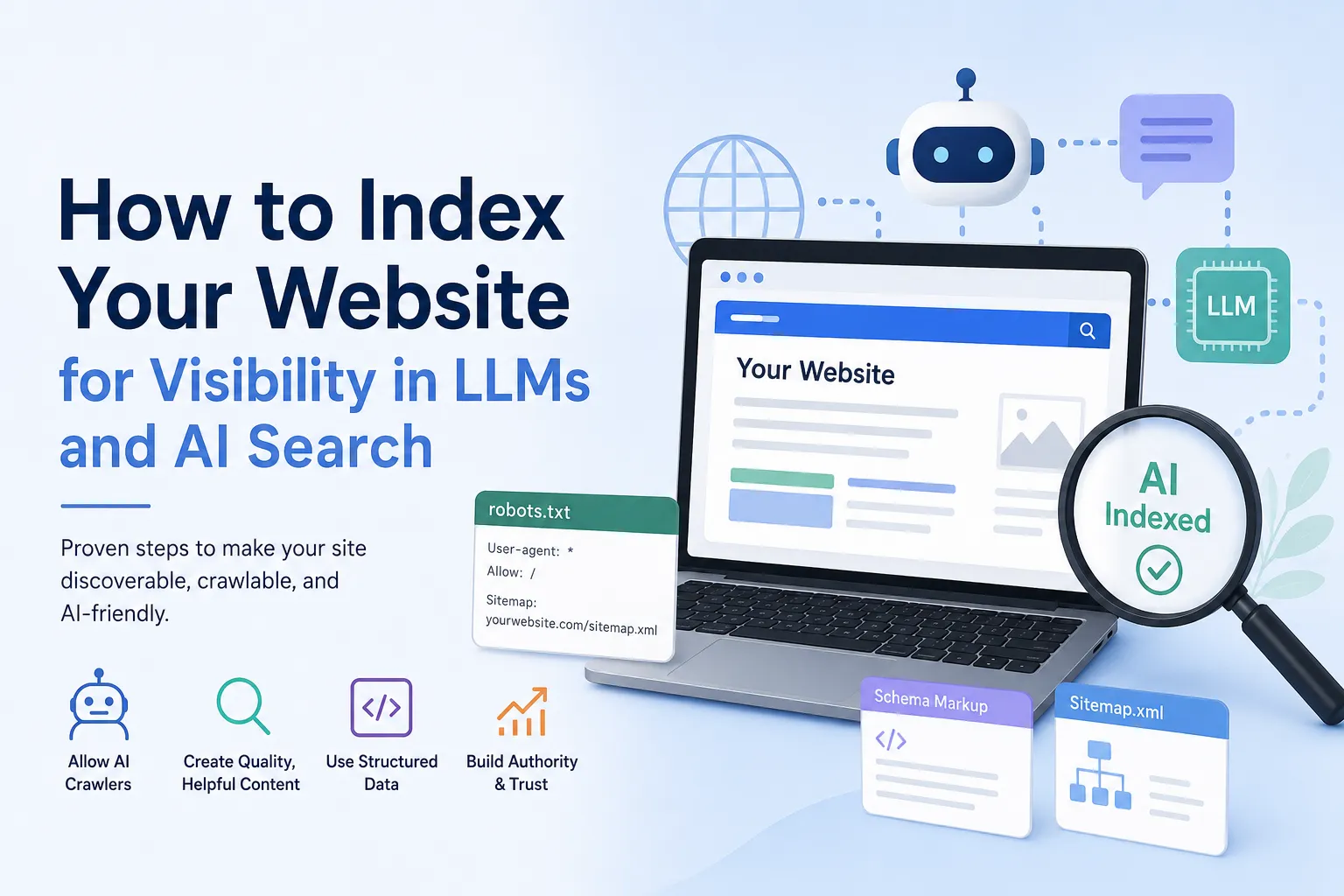
If your goal is to index your website for visibility in LLMs, you should focus on both traditional SEO and AI accessibility.
The following best practices can improve your chances of being discovered, crawled, and cited by large language models.
1. Make Sure Your Website Is Crawlable
Many AI systems rely directly or indirectly on web crawlers and search engine indexes. Ensure that:
- Your pages return a
200 OKstatus. - Important pages are not blocked in
robots.txt. - Pages are not marked with
noindex. - Content is available in HTML and not solely rendered via JavaScript.
- XML sitemaps are available and submitted to search engines.
User-agent: *
Allow: /

Sitemap: https://example.com/sitemap.xml
2. Allow AI Crawlers
Several AI companies operate their own crawlers. Common examples include:
- GPTBot (OpenAI)
- ClaudeBot (Anthropic)
- PerplexityBot
- Google-Extended
- Bytespider (TikTok)
Ensure these crawlers are not blocked in your robots.txt file.
User-agent: GPTBot
Allow: /

User-agent: ClaudeBot
Allow: /

User-agent: PerplexityBot
Allow: /
Reference:
OpenAI GPTBot Documentation
3. Build Topical Authority
LLMs tend to surface sources that demonstrate expertise and comprehensive topic coverage.
For example, if you operate an auto parts website, create:
- Category pages
- Buyer guides
- Troubleshooting content
- Frequently asked questions (FAQs)
- Comparison articles
- Glossary pages
A cluster of 50 high-quality articles usually performs better than a handful of isolated articles.
4. Implement Structured Data
Schema markup helps search engines and AI systems better understand your content.
Consider implementing:
- Article Schema
- FAQ Schema
- Product Schema
- Organization Schema
- LocalBusiness Schema
- HowTo Schema
Your Organization schema should clearly define:
- Company name
- Website URL
- Logo
- Social media profiles
- Contact information
5. Answer Questions Directly
AI systems often prefer concise, direct answers that can be easily extracted and referenced.
Instead of writing:
SEO is a broad field with many considerations…
Write:
SEO is the process of improving a website’s visibility in search engines through content, technical optimization, and authority building.
After providing the direct answer, expand with supporting details and examples.
6. Build Brand Mentions Across the Web
Modern AI search systems rely heavily on entity recognition and brand authority.
Aim to have your brand mentioned consistently across:
- Industry websites
- Forums
- Podcasts
- Interviews
- YouTube channels
- Social media platforms
- News publications
The more consistently your brand is mentioned online, the more likely it is to be recognized as a trusted entity.
7. Get Indexed by Major Search Engines
Many AI systems rely on existing search engine indexes.
Prioritize indexing through:
Bing is particularly important because several AI-powered search products leverage Bing’s search index.
8. Create an llms.txt File
An increasing number of websites are adopting the llms.txt standard to help AI systems understand important site resources.
# Company Name

About:
https://example.com/about

Products:
https://example.com/products

Documentation:
https://example.com/docs

Contact:
https://example.com/contact
While not yet a universal standard, adoption continues to grow.
Reference:
llms.txt Project
Related: How to Add llms txt to WordPress?
9. Monitor AI Visibility
Regularly test whether your brand and content appear in AI search experiences such as:
- ChatGPT Search
- Perplexity
- Gemini
- Claude
- Bing Copilot
Ask the same questions your potential customers would ask and evaluate whether your content is surfaced in responses.
10. Focus on E-E-A-T
The strongest signal across both traditional search engines and AI search systems is trustworthy, experience-driven content.
Include:
- Real author information not a John or Jane Doe 😅
- First-hand experience
- Original images
- Data and research
- References and citations
- Updated publication dates
Conclusion
For most websites, there is no special “LLM index” to submit to. The most effective strategy is to create high-quality, crawlable, structured, and authoritative content that search engines and AI crawlers can access, understand, and trust.

This is Muhammad Asad. I like to play table tennis and love Digital Marketing and SEO. I have 7+ years of SEO experience. I would love to chat, discuss or break down any SEO or website problem.